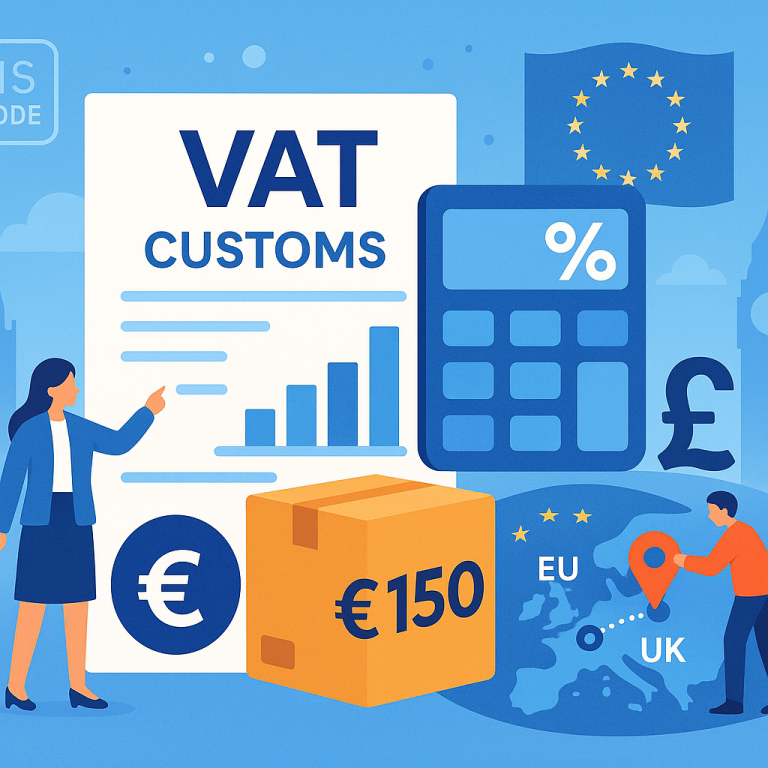
From 2026, the European Union will remove the 150 EUR customs duty exemption threshold on low-value goods imported from non-EU countries through e-commerce platforms. This marks a significant shift in the way import duties are applied and collected within the EU. UK businesses engaged in cross-border e-commerce, particularly those selling into or sourcing from the EU, will need to adapt quickly to meet evolving compliance and cost structures. This article helps UK-based businesses and VAT professionals understand the implications and prepare strategically for the change.
Understanding the Removal of the €150 De Minimis Customs Duty Threshold
Current Rules Until 2026
Currently, parcels valued under €150 are exempt from customs duties when imported into the EU. While VAT on these consignments must be declared and paid, the customs duty exemption has enabled significant volumes of low-value imports to enter the EU without incurring additional import tariffs.
What Will Change in 2026?
From early 2026, the EU will eliminate the €150 customs duty relief threshold. This means that all goods imported into the EU—regardless of value—may be subject to customs duties, in addition to applicable VAT. In support of this measure, the EU also aims to implement a temporary system for collecting customs duties on e-commerce goods prior to the full launch of the EU Customs Data Hub and EU Customs Authority in 2028.
This change is part of the EU’s broader initiatives to improve fair competition, combat VAT and customs duty fraud, and create a level playing field between EU-based sellers and non-EU online retailers.
Implications for UK Businesses Selling into the EU
Impact on Pricing and Cost Structures
UK businesses that export low-value products to EU consumers will see an increase in the landed cost for their customers, since customs duties may now apply even below €150. Businesses may need to reconsider their pricing models, shipping policies, or consider absorbing part of the increased duty costs to remain competitive in EU markets.
Changes to Import Processes and Platforms
UK sellers will need to work with customs agents or shipping providers that understand the updated requirements. This includes the accurate declaration of the customs value, proper product classification (HS codes), and connectivity to any new EU-wide customs duty collection systems that may be introduced temporarily before 2028.
Interaction with the EU VAT Import One Stop Shop (IOSS)
Many UK e-commerce businesses currently use the EU Import One Stop Shop (IOSS) to simplify VAT collection and reporting for consignments below €150. From 2026, the coexistence of IOSS with new duty collection rules will necessitate close attention to dual obligations: paying VAT at the point of sale and potentially collecting customs duties at import or through designated platforms.
Compliance Considerations for UK-Based Retailers and Online Marketplaces
Best Practices to Prepare Before 2026
- Review your product portfolio: Identify which products are currently under €150 but would be affected by new customs duties.
- Simulate future landed costs: Estimate the impact of potential tariffs and customs duty rates using your product HS codes.
- Update shipping terms and communications: Clearly inform EU customers about possible changes in total payable amount—including customs duties—at checkout.
- Monitor EU regulatory communications: Track the implementation timeline for the temporary customs duty system through the EU Taxation and Customs Union site.
- Evaluate logistics partners: Ensure your customs broker or third-party logistics provider is equipped to handle both VAT and the new customs duties efficiently.
- Consider IOSS or intermediary service registration: This remains the most effective way to manage EU VAT on B2C shipments, even as customs duty processes evolve.
Practical Example: Fashion Retailer Exporting to EU
Scenario: A UK-based fashion brand exports low-cost accessories (average order value: €120) to customers across Germany, France, and Spain. It currently uses the IOSS scheme to handle VAT compliance seamlessly.
Current Situation: Products are charged with EU VAT at the point of sale but are exempt from customs duties due to the €150 threshold.
Post-2026 Impact: These same products may now incur customs duties of 12% (average duty on accessories), increasing the effective landed cost for EU consumers by up to €14.40 per order. Without adjusting pricing, the retailer risks decreased competitiveness or higher cart abandonment rates.
Actions Taken:
- Conducts full cost impact modelling using HS tariff codes.
- Negotiates bulk customs brokering arrangements with an EU-based logistics provider.
- Updates checkout to allow prepayment of estimated customs duties.
- Explores setting up limited fulfillment options within the EU to reduce cross-border friction.
Key Dates and Confirmed Developments
| Milestone | Expected Date | Description |
|---|---|---|
| Political Agreement on Relief Removal | April 2024 | EU Council reaches agreement to remove the €150 threshold. |
| European Parliament Support | July 2025 | Parliament endorses reform in resolution on e-commerce compliance. |
| Implementation of Relief Removal | Early 2026 | €150 customs duty relief officially abolished. |
| Launch of Temporary Duty Collection Solution | Early-to-mid 2026 | Expected rollout of interim EU-wide duty collection platform. |
| EU Customs Data Hub & Agency Operational | Mid-2028 | Full digital infrastructure for EU customs and VAT regime. |
Conclusion: Prepare Early to Protect Your Cross-Border Sales
The removal of the €150 customs duty exemption is a significant shift that will directly impact UK exporters and e-commerce sellers. Businesses must proactively review product classifications, reassess landed cost calculations, and work closely with customs and VAT intermediaries. By preparing ahead of the 2026 implementation, UK businesses can maintain compliance, control cost exposure, and stay competitive in a rapidly evolving EU market landscape.
For continued updates on EU import processes and UK VAT compliance requirements, visit the official pages of HMRC’s VAT guidance or the EU Taxation and Customs Union.