VAT (Value Added Tax) is a consumption tax applied to most goods and services sold in the UK and across Europe. It is charged by VAT-registered businesses, collected at each stage of the supply chain, and ultimately borne by the final consumer. Understanding VAT is essential for business owners and finance professionals to ensure compliance, manage pricing, reclaim input VAT, and navigate cross-border transactions within the UK and EU. This guide outlines the essentials of VAT in 2025, focusing on UK rules with key references to European practices.
What Is VAT and How Does It Work?
VAT is a tax added to the price of goods and services at each point of sale. Although it is collected by businesses, the final burden of the tax falls on the consumer. In the UK, VAT is administered by HM Revenue & Customs (HMRC).
VAT in Simple Terms:
- A business charges VAT on sales (called output VAT).
- A business pays VAT on purchases and expenses (called input VAT).
- If output VAT is higher than input VAT, the business pays the difference to HMRC.
- If input VAT exceeds output VAT, the business can reclaim the difference from HMRC.
Who Needs to Register for VAT?
A business must register for VAT if its taxable turnover exceeds the current UK registration threshold, which is £90,000 (as of April 2024). Businesses can also register voluntarily if their turnover is below this threshold, which could be advantageous if they incur significant input VAT.
VAT Registration Checklist:
- Track monthly turnover against the 12-month threshold.
- Register through the official HMRC VAT registration portal.
- Receive a VAT registration number, certificate, and official start date once approved.
Applicable VAT Rates in the UK
There are three main rates of VAT charged in the UK, depending on the type of goods or services supplied.
| Rate | Percentage | Examples |
|---|---|---|
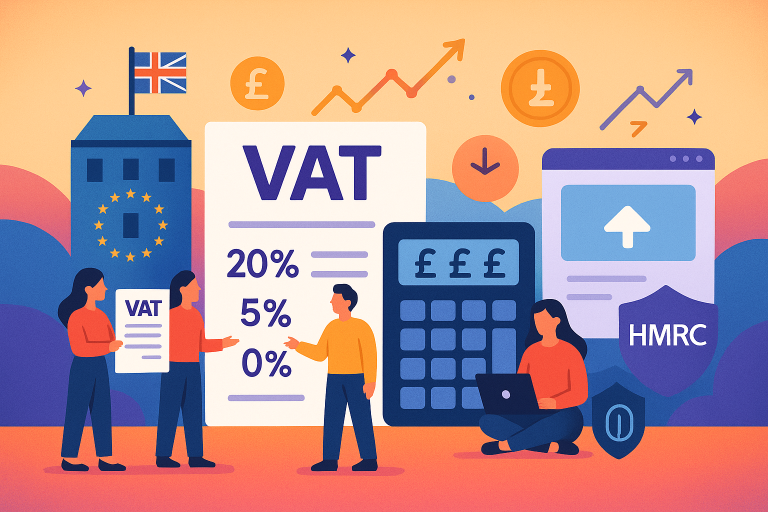
| Standard Rate | 20% | Most goods and services including electronics, consulting, and clothing |
| Reduced Rate | 5% | Home energy, children’s car seats, mobility aids for older people |
| Zero Rate | 0% | Food, children’s clothing, books, newspapers |
Some items are VAT exempt (e.g., insurance, health services, education), which means they fall outside the VAT system — no VAT is charged, and related input VAT cannot be reclaimed.
How to Charge and Reclaim VAT
Charging VAT:
- Include VAT on invoices with proper formatting (show VAT rate, amount, and registration number).
- Use VAT-inclusive pricing for consumers and clearly distinguish VAT-exclusive pricing for B2B sales.
Reclaiming VAT:
- Only VAT-registered businesses can reclaim VAT on eligible business-related purchases.
- Ensure proper documentation (invoices with VAT breakdown, proof of payment).
- Regularly file VAT returns via Making Tax Digital for VAT.
VAT Compliance Essentials
Filing and Payment Schedule:
- VAT returns are usually filed quarterly and must be submitted within one calendar month and seven days after the end of the accounting period.
- Payment of any VAT due must be made by the same deadline.
All VAT returns must be submitted using compatible software under the UK’s Making Tax Digital (MTD) scheme. For more information, consult the HMRC MTD guidelines on Making Tax Digital for Business.
Common Compliance Errors:
- Incorrect VAT rates applied to products or services
- Late registration or deregistration
- Failure to issue compliant VAT invoices
- Not maintaining digital records as required by MTD
Cross-Border VAT in the UK & Europe
If your business trades across UK or EU borders, VAT compliance becomes more complex but manageable.
Key Considerations Post-Brexit:
- UK businesses exporting to the EU generally apply zero-rated VAT but must comply with EU import VAT rules in the receiving country.
- For sales to EU consumers, the EU VAT One Stop Shop (OSS) can be used to simplify VAT registration across multiple EU countries.
- Goods imported into the UK are subject to UK import VAT and potential customs duties.
The use of Economic Operators Registration and Identification number (EORI) remains essential for UK-EU imports and exports. Apply via HMRC’s EORI portal.
Why VAT Knowledge Matters
A solid understanding of VAT has significant implications for:
- Pricing Strategy – Accurate VAT application ensures competitive pricing and profitability.
- Cash Flow – Timely reclaims of input VAT can significantly impact liquidity.
- Legal Compliance – Avoid penalties and audits by staying compliant with filing and recordkeeping obligations.
- International Trade – Managing EU VAT obligations boosts export readiness and customer trust.
Next Steps for Business Owners
- Review your annual turnover against the registration threshold (£90,000).
- Register for VAT if required and familiarise yourself with VAT return schedules.
- Use compliant accounting software for Making Tax Digital submissions.
- Stay informed on future VAT changes via HMRC and European Commission updates.
For further guidance, the following sources provide additional insights and tools:
Understanding and managing VAT is a vital part of running a business in the UK and Europe. Staying informed helps you remain compliant, optimise financial operations, and support international growth.